|
AZentertain: Arizona Gold Rush The Lost City in the Cañada del OroThere is a persistent legend of an ancient, lost city located somewhere in the Santa Catalinas Mountains along Cañada del Oro, north of Tucson, Arizona. There is truth to the legend.
The lost city may an Indian rancherita, a Spanish mining camp or a mission. The lost city, which is often associated with having a mission, lies within proximity of the lost mine, according to the legends. Rediscovering the Lost City of the Catalinas during the 1880s gold rushOne of the first accounts of a lost civilization in the interior of the Catalinas was reported in an article in the Arizona Weekly, 1881. An account of a "New Discovery" was reported in the Tombstone Arizona newspaper in February 1891 that described:
The Nine Mile City, Nueva Mina CiudadThe lost city was referred to as the Nine Mile City, "Nueva Mia Ciudad," because it was located 9 miles from some specified location. 2 But, the early Spanish, however, did not use miles as a measurement. They counted distance by leagues, ligas. One league is 3.45 miles. Nine leagues is about 31 miles- the distance from one of the early Tucson settlements to the old city. Perhaps, it should have been called Nueva Liga Ciudad. In that case, the lost city would be 30 miles from Tucson's town center, "Many ruined buildings" in the CatalinasAn account of "many ruined buildings" was published in the Record Union on April 1, 1881- April Fool's Day, according to a reference by Rascoe in "Old Arizona Treasures." The article, told by an Arizona editor, described "cities" that were on the western slope of the Catalinas. 3 The article, said that visitors had found "many ruined buildings," and "squares of stone set on end about eight fee by ten feet in size, as well. These squares were said scattered all about the area. One of these early adventures, perhaps not realizing the historic value of such "trinkets" found, in addition to the pottery, stone metates, bowls, axes and other relics, which also were scattered about the ground. The author further described from the article that "On the slope in a cave we found skeletons of a race of people who when alive were above the stature of the present day." 3 There was a lake in the cave that contained fish without eyes. On the northern slope of this same mountain more ruins were discovered along with placer diggings. They called the town site Pueblo Viejo.
Pueblo Viejo- destroyed by the ApachesHowever, a search of Arizona newspapers mentions the closest Pueblo Viejo to Tucson being located in the Gila Valley in Graham County. Ads in Arizona newspapers in 1885 mention Pueblo Viejo as a freight stop for J. Liberman & Co., a wholesale and retail dealer in general merchandise. 7 Other "forwarding and commission merchants" also delivered goods to a location called Pueblo Viejo from 1881 through 1885. This site was apparently located near Willcox, Arizona. The name Pueblo Viejo means Old Village or Old Town. While this reference is only used in the 1881 news article above, it is most likely not the same site mentioned in Gila Valley. Another reference to a city of Valley Viejo, and the lost mission of Ciru connected the Mine with the Iron Door with the related Spanish legends. This writer described that the Apache's "swooped down upon the Spaniards and their Mining Slaves slaughtering the entire Cities Inhabitants in one massive surprise attack." The Apache's the destroyed this mission and the "New Gold Canyon City." 4 No year is given for this event. Rediscovering the discovered lost city, again, in 1895A few years later in 1895, an article in another Arizona newspaper described a "Barn Door" mine, nearby ruins of arastras, a furnace which prepared sands for molds:
There are no available archeological records, excavations or documentation, outside of newspaper accounts and the general legend, of a city within the Catalina mountain range. One report issued by the Forest Service on the Samaniego Ridge in 2010. The Samaniego Ridge PWA is located immediately west of the Marble Peak mining district, which straddles Oracle Ridge. The report describes the Potential Wilderness Area's (PWA) heritage resources as
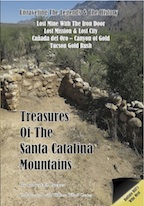
Was there actually ever a community that lived in the Catalinas? Harold Bell Wright's home away from homeOne famous resident who lived in the Santa Catalina mountains was author Harold Bell Wright, who wrote the Mine With The Iron Door. His novel became the basis for the series of movies with the same name, and several spawned treasure stories. Wright lived in a cabin he built within the basin of the Santa Catalina Mountains, near the Cañada del Oro. 6 Wright's 1923 novel about the Iron Door Mine, woven into a murder-mystery, was a popular book of its time. Wright's Cañada del Oro was the location of the Mine with the Iron Door. One Park PlaceAnother resident of the Catalinas occupied a remote cabin that still stands today. Known as One Park Place, this building was part of the Catalina Camp which conducted mining activities during the 1940s. Explore the Treasures of the Santa Catalina MountainsA new book about the legends of the lost mine of the Santa Catalinas and the Iron Door Mine are explored in the context of history and the stories recorded over the centuries. Read sample chapters from the Treasure of the Santa Catalinas. Purchase on Amazon. Treasures of the Santa Catalina Mountains is now available online for a discount at amazon.com. Save money and even reduced shipping when you order from amazon. Also available digitally as an Amazon Kindle version. Author Available to Share Legends and HistoryRobert Zucker, author of "Treasures of the Santa Catalina Mountains," is available to speak to your group or organization about the history and legends of the Catalina Mountains, including a presentation on the famous Iron Door Mine legend of the Catalinas. To arrange a presentation book talk, call 520-623-3733 or email publisher@emol.org. Footnotes: 1. Tombstone Prospector, 2-17-1891. The article was also published in the Tombstone Epitaph on February 2, 1891. 2. According to a typed article from the Tucson Citizen, Star 1880. 3. "Old Arizona Treasures" by Jesse Rascoe. Frontier Book Company, Texas, 1968. Page 59. 4. The Legend of Wyatt Westwood and the Mine with the Iron Door. 4. Mohave County Miner, 6-15-1895, image 1 5. Coronado National Forest, Draft Samaniego Ridge Potential Wilderness Area Evaluation Report PW-03-05-D5-001, March 2010. United States Department of Agriculture Forest Service. Final Draft. 6. Photo: Harold Bell Wright standing next to shack in the Santa Catalina Mountains outside of Tucson. Northern Arizona University Cline Librarty Special Collections and Archives. Colorado Plateau Digital Archives Collection. Graphics from DeskGallery clip-art library, 1994 Zedor, Inc. NEXT:The Lost City MapThe Great Tucson Earthquake
Arizona Gold RushFlint Carter's Lost City ExplorationAZentertain Home© 2011-2017 AZentertain.com. All rights reserved. Entertainment Magazine network. BZB Publishing, Inc. |
 The
legends about people living deep inside the mountains is often
connected to the lost mine of the Spaniards near the same location.
The
legends about people living deep inside the mountains is often
connected to the lost mine of the Spaniards near the same location.